Table Linens
PRACTICAL FABRIC GUIDE

Table linens: types, fabrics, fit and care

Start with the job each textile must do: cover the whole tabletop, define a center strip, protect individual places, or provide a reusable dining napkin. Then compare fiber, construction, dimensions and cleaning needs.

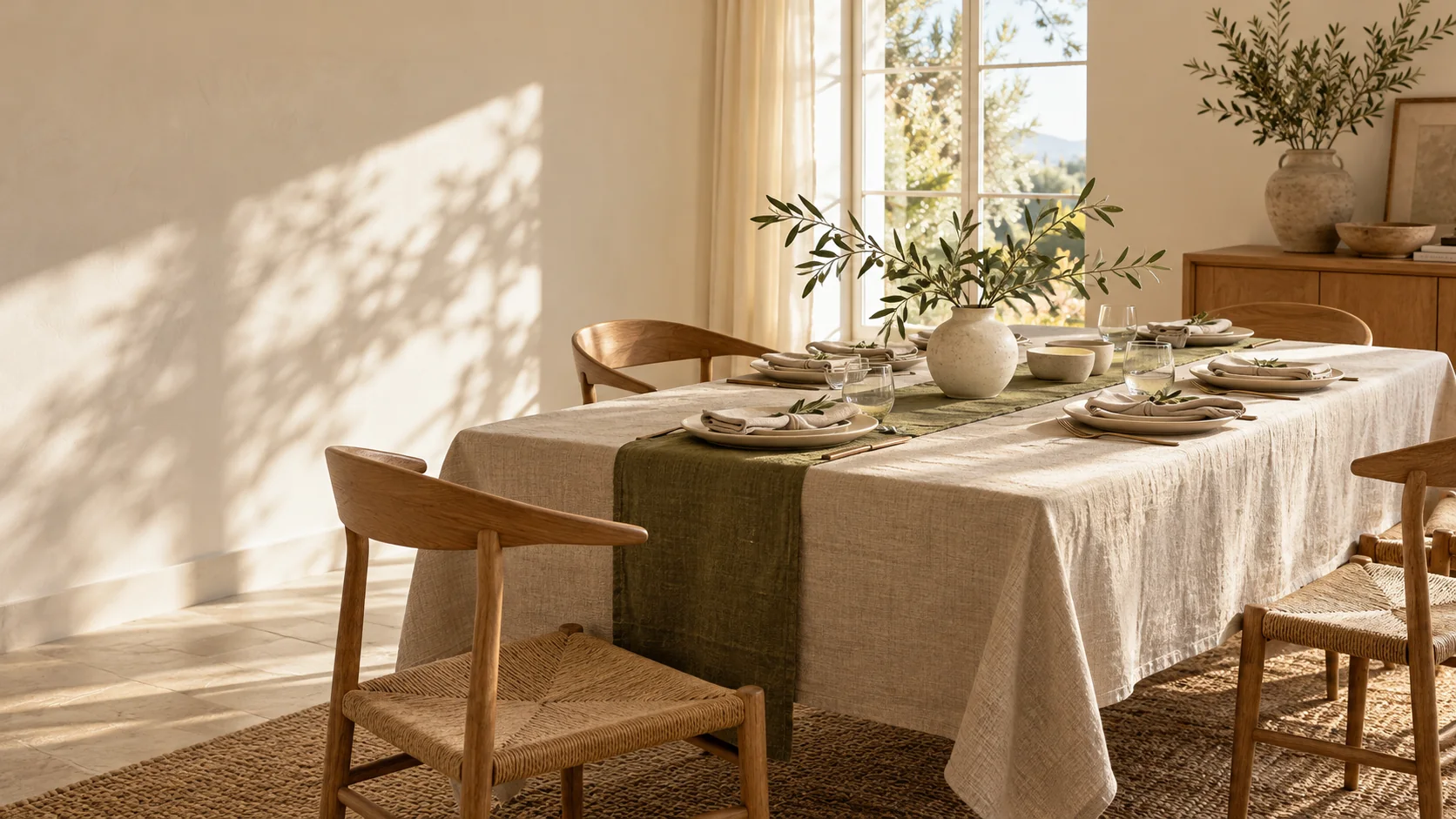
Dining table styled with a tablecloth, runner, and cloth napkins
Function: full, center or place setting Fiber: cotton, flax linen, polyester or blend Fit: tabletop size and desired overhang Care: stains, finishes and washing method
01 / QUICK DECISION PATH

Which three decisions matter first?

"Table linens" names the category; "linen" can also mean a fabric made from flax fiber. Keep the item's function, its fiber content and its construction separate when comparing options.

  1. Choose the coverage

    A tablecloth covers the tabletop and can hang over the edges; a runner occupies a narrower strip; placemats mark individual settings; napkins are used by diners. These roles can be combined.

  2. Read the actual fiber content

    Fiber influences absorption, wrinkling and heat sensitivity; weave, finishing and blends change the result. US textile-content labeling covers tablecloths and napkins - do not infer fiber from a texture or marketing name.

  3. Measure before choosing a size

    For an evenly draped rectangular cloth, each finished dimension equals the tabletop dimension plus twice the desired drop. Round cloth diameter follows the same geometry. Drop is a choice, not a universal required length.

02 / FUNCTIONAL FORMATS

What does each table linen format do?

Choose by the area and purpose: a full-table covering, a narrow decorative strip, an individual place-setting surface, or a diner's reusable napkin. The formats can be layered, but coverage alone does not establish spill or heat resistance.

TYPE-01 / FULL-TABLE COVERAGE

Tablecloth

A cloth spread over a table, usually covering the tabletop and optionally hanging over its edges. Shape and finished dimensions determine the coverage; the drop on each side depends on the table and the look desired.

Footprint
Whole tabletop
Fit check
Shape + length/width or diameter + drop

Limit: Ordinary woven cloth is not automatically waterproof or safe beneath hot cookware.
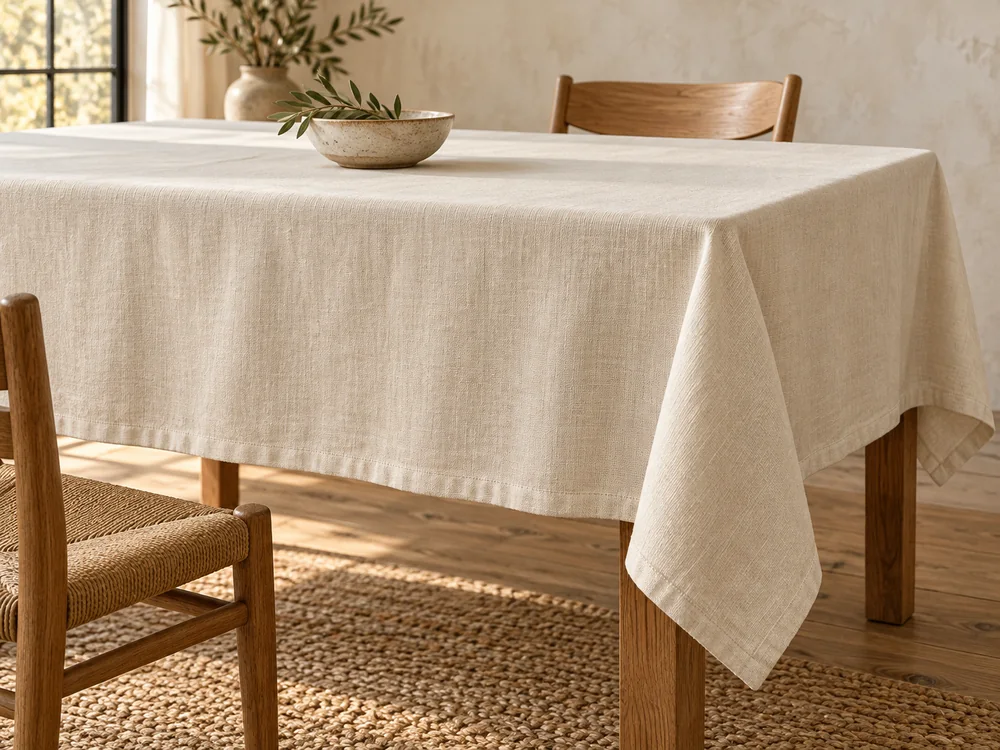
Fabric tablecloth covering a rectangular dining table with visible edge drape
A tablecloth covers the tabletop and extends over its edges.
TYPE-02 / CENTER STRIP

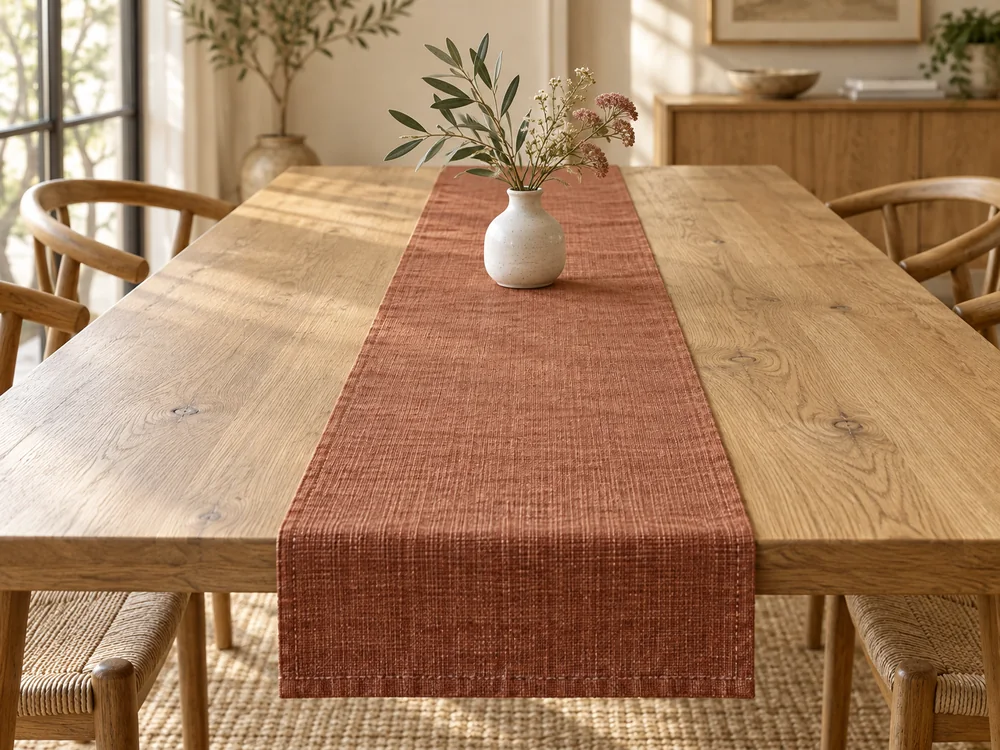
Table runner

A narrower strip placed along the table for decoration or to define a central zone. It can sit on a bare surface or over a tablecloth; width, end overhang and usable space for dishes matter.

Limit: It leaves much of the tabletop exposed.

Table runner centered on an otherwise uncovered dining table
A runner accents the center while leaving much of the tabletop visible.
TYPE-03 / INDIVIDUAL SETTING

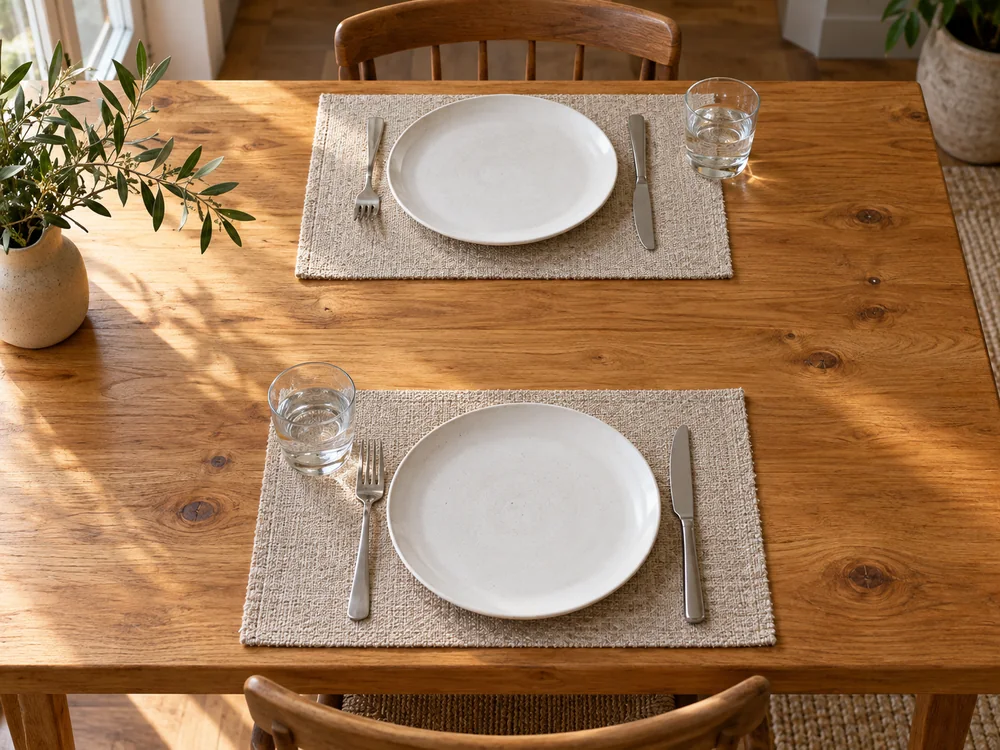
Textile placemat

A smaller piece placed under one diner's plate and utensils. It marks the setting while leaving some table visible; enough room for the actual dinnerware matters more than a universal nominal size.

Limit: Thin or open fabric may let liquid reach the table.

Separate textile placemats beneath dining place settings
Placemats define individual settings rather than covering the whole table.
TYPE-04 / DINER USE

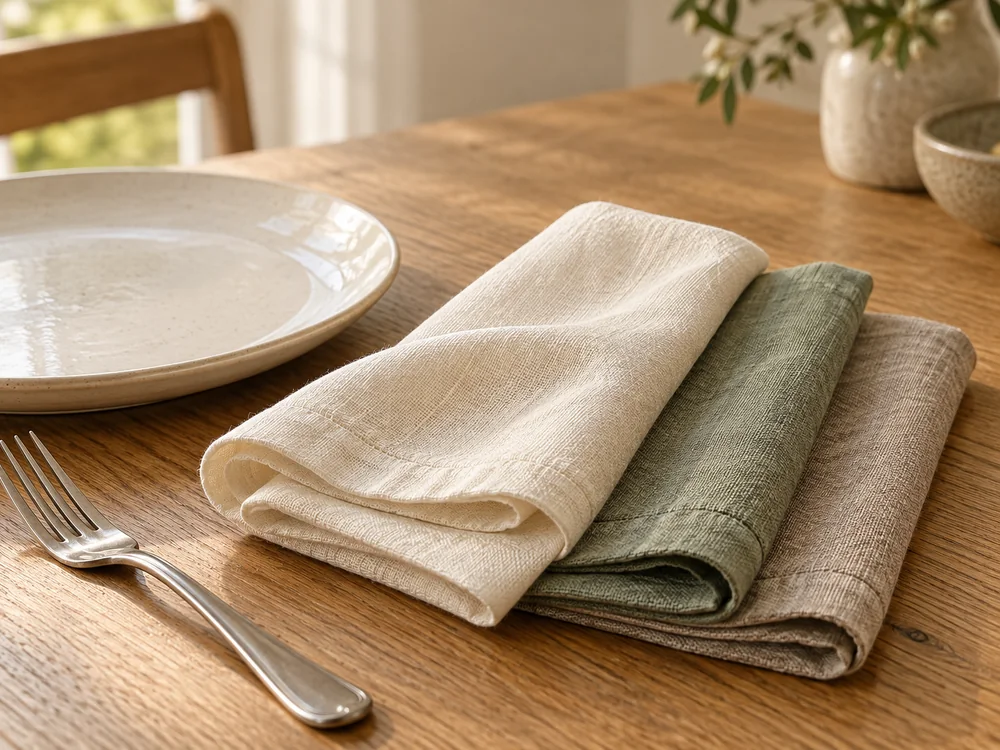
Cloth napkin

A reusable textile handled by the diner to protect clothing and wipe fingers or lips during meals. Absorption, softness, laundering and stain handling matter more than tabletop coverage.

Limit: It is not a table covering or a heat pad.

Folded cloth napkins beside a simple table setting
Cloth napkins are reusable pieces for individual diners.
03 / COMPOSITION AND CONSTRUCTION

Fiber vs. weave: what do textile terms actually mean?

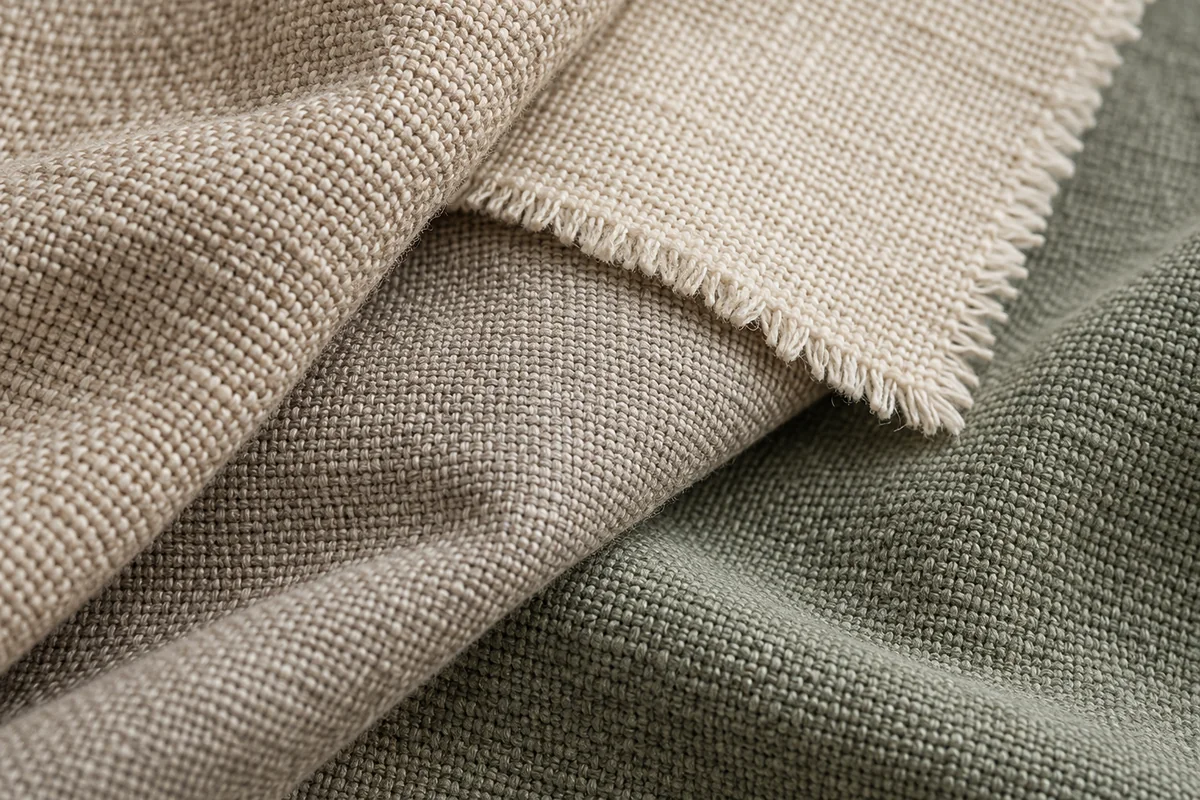
Fiber identifies the material; weave describes how yarns interlace; finishing can change appearance and performance. A fiber-content percentage is measured by weight, not by surface area, and does not specify the weave or cleaning method.

Close-up of woven fabric samples showing different thread textures
Fiber content and fabric construction describe different properties.

Read three different kinds of description

Fiber or blend
What the yarns contain: cotton, flax linen, polyester or a combination. US fiber-content labels give constituent percentages by weight.
Weave or fabric structure
How lengthwise warp yarns and crosswise weft yarns interlace. Plain, twill and satin are basic woven designs; they are not fiber names.
Finish or treatment
Processing that may alter softness, wrinkling or water repellency. The underlying fiber name alone does not prove a particular finish or protective rating.
CONCEPTUAL WOVEN-FABRIC PATH
  1. FiberCotton, flax or polyester
  2. YarnFibers formed into strands
  3. Woven fabricWarp and weft interlaced in a design
  4. Optional finishAppearance or performance treatment
How woven textiles are made, from fiber to finished fabric. Knitted and other constructions also exist.
PLANT FIBER

Cotton

Absorbent natural cellulosic fiber that can make practical dining textiles. Wrinkling is common without suitable treatment, and a fabric's weave and finish alter its feel and care.

Check: Shrinkage and color behavior are not determined by fiber name alone.

PLANT FIBER

Flax linen

A natural flax-based fiber with good moisture transport and a characteristic tendency to crease. Repeated sharp folding in the same place can weaken the textile over time.

Check: "Table linens" as a category does not mean every item contains flax.

MANUFACTURED FIBER

Polyester

A synthetic fiber associated with wrinkle resistance and easy wash-wear handling. It can retain oily soil and is sensitive to excessive ironing heat.

Check: Synthetic composition alone does not mean stain-proof or heat-proof.

MULTIPLE FIBERS

Blends and combinations

Two or more fibers may be mixed within yarns or placed in different yarn systems. Their proportions and construction matter; the result cannot be predicted from the word "blend" alone.

Check: Read the actual fiber percentages and construction details.

04 / MATERIAL COMPARISON

How do common table linen fibers compare?

Cotton and flax linen generally take up moisture but crease; polyester tends to resist wrinkling yet is heat sensitive and less absorbent. Blends depend on their components. Construction and finishing also affect the finished cloth.

Qualitative fiber-family comparison. Construction, treatment, dyes, laundering and blend ratio can change the outcome.
Fiber family Moisture behavior Wrinkles and appearance Heat / pressing Stain and care watch-out
Cotton Natural cellulosic Absorbent. Readily takes up liquid; absorption of the finished fabric also depends on construction and finish. Creases unless treated. Wrinkle-resistant finishes can alter appearance and handling. Can scorch. It does not melt as polyester does; any applied finish may change safe care. Pre-treat oily soil. Check colorfastness and any wrinkle-resistant treatment before bleaching or pressing.
Flax linen Natural cellulosic Wicks moisture. Natural linen can dry relatively quickly. Creases readily. A smooth pressed appearance takes maintenance; repeated hard folds can weaken the fabric. Can scorch. Avoid assuming a universal iron setting for dyed or embellished cloths. Pre-treat oily soil; avoid leaving sharp creases in long-term storage.
Polyester Manufactured synthetic Low moisture absorption. Typically dries readily after wetting. Wrinkle-resistant. Can retain heat-set creases, but static and pilling may occur. Melts at excessive heat. Use conservative pressing conditions appropriate to the textile. Oil and grease can persist; spot pre-treatment may be needed before laundering.
Blends Two or more fibers Composition-dependent. Plant fibers can increase absorbency relative to an all-synthetic counterpart. Composition-dependent. Synthetic content may improve wrinkle recovery, but does not guarantee it. Mixed constraints. Respect the heat sensitivity of all constituent fibers, finishes and trims. Read actual fiber percentages and care information. The word "blend" alone predicts no fixed performance.
05 / MEASURING AND FIT

How do tabletop shape and drop determine cloth size?

Measure the tabletop itself, then choose how far the cloth should hang below its edges. For a centered, evenly draped rectangular or round tablecloth, finished cloth size equals the tabletop span plus the desired drop on both sides.

Rectangle or square

Rectangular tabletop within a larger flat tablecloth outline A smaller white rectangle represents the tabletop and a larger green rectangle represents the flat cloth. Equal bands on opposite sides are labeled d for the desired drop. The drawing is schematic and not to scale. d d Tabletop Flat cloth outline
Finished length = tabletop length + 2d. Finished width = tabletop width + 2d. The square case uses the same rule on both axes.

Round

Circular tabletop within a larger circular flat cloth outline Two concentric circles show the tabletop and the flat cloth. A radial band between the circles is labeled d, the desired drop. The diagram is conceptual and not to scale. d Tabletop Flat cloth outline
Finished cloth diameter = tabletop diameter + 2d. Measure tabletop diameter across the center; use the same unit for diameter and drop.
01 / Measure
Record length and width for a rectangle or square, or diameter for a circle. Measure the table in its actual use configuration, including leaves if extended.
02 / Choose drop
Drop d is the intended distance below the tabletop edge. Check table height and seating clearance; no universal drop length is required.
03 / Check finished size
These equations calculate finished cloth dimensions, not cutting dimensions. If sewing, allow for hem and seam construction separately; laundering may change size.
06 / DIMENSION TOOL

Calculate finished tablecloth dimensions

Enter a tabletop shape, its dimensions in inches, and the drop you want on each side. The calculator adds twice that drop. It computes finished flat-cloth dimensions, not sewing cut sizes or a guaranteed fit around irregular edges.

All measurements are in inches. Enter up to two decimal places.

Rectangular tabletop
Square tabletop
Round tabletop
Enter your measurements. The calculation button becomes available when scripting loads.
07 / CHOOSE BY USE

Which table linen setup suits the meal?

Start with the surface area that matters, then match the fabric to how often you will wash or press it. Tablecloths, placemats and runners solve different coverage tasks; cloth napkins serve diners independently of the tabletop layer.

START HERE

What should the fabric cover?

Follow the option that best matches what you want the fabric to cover.

IF / THE WHOLE TOP

Tablecloth + napkins

Use a cloth sized to the table shape and chosen drop when a continuous surface is the priority.

Check
Finished dimensions and laundering needs
Tradeoff
A larger textile to clean and press
IF / EACH DINER'S AREA

Placemats + napkins

Define individual settings while leaving some tabletop visible. Lay out the actual plates and utensils before deciding dimensions.

Check
Enough space at every setting
Tradeoff
Uncovered gaps between mats
IF / A CENTER ACCENT

Runner + napkins

Define a narrow central zone without covering every diner's place. A runner can also sit over a tablecloth if that layering has a purpose.

Check
Room for serving pieces and settings
Tradeoff
Most of the tabletop remains exposed
Across all branches: Napkins are a separate diner-use textile. A clean, bare table is also a valid starting point; no tablecloth or placemat layer is compulsory.

Adjust the configuration to the occasion

Practical combinations based on coverage, available table space and fabric care.
PriorityUseful setupCheck before useMain compromise
Frequent everyday mealsPlacemats and cloth napkins, or a washable tablecloth with napkins.Fabric care, stain handling and the available table space.Absorbent cotton can crease; polyester can retain oily soil.
Occasional dressed settingA tablecloth and napkins; add a runner only for a distinct center accent.Desired drape, coordinated footprint and time available for pressing.Extra layers mean more fabric and setup, not automatic protection.
Compact or crowded tableUse mats only if individual settings fit; otherwise consider a narrow runner or bare surface with napkins.Lay out actual dinnerware; keep the center and edge clear.A decorative layer may take space needed for serving.
Hot or spill-prone serviceChoose washable linens for appearance and cleanup, plus purpose-made protection where necessary.Use a trivet or suitable protector beneath hot serving dishes; check actual liquid-barrier properties separately.Ordinary textile coverage is not a heat or waterproof rating.
08 / CLEAN, PRESS, STORE

How should table linens be cleaned and stored?

Work from the stain to the fabric, then to the cleaning method. Prompt treatment helps, but the fiber name alone cannot tell you which bleach, water temperature, drying method or iron setting is safe for the finished textile.

  1. Lift the spill promptly

    Remove loose food gently. Blot liquid with a clean absorbent cloth rather than rubbing it across the fabric. Identify the stain if possible; different soils need different treatments.

  2. Check instructions and colorfastness

    Read any care information supplied for the textile, including trim or coating restrictions. Test a proposed cleaning agent on an inconspicuous area first. Do not assume every table linen has an apparel-style mandatory care label.

  3. Pre-treat for the specific soil

    For coffee or tea on a washable fabric, UGA Extension advises prompt cool-water sponging or rinsing, then a compatible detergent pre-treatment. Oil or grease also needs pre-treatment. Avoid untested chemical mixtures or bleach on uncertain dyes and finishes.

  4. Launder within fabric limits

    Use a wash method, detergent, and temperature compatible with the actual fiber blend, dyes, finishes and trim. Chlorine bleach is not a default for colored or treated textiles; use it only when the fabric's instructions allow it.

  5. Inspect before heat and press carefully

    Check for remaining stains before machine drying, since heat can set them. Dry according to the textile's instructions; when pressing is appropriate, remember that polyester may melt under excessive heat, while cotton and flax linen can scorch.

  6. Store clean and completely dry

    Choose a clean, cool, dry, dark location. For long-term or heirloom storage, avoid sharp, weighted folds; padded folds or flat storage can reduce strain. Conservation handling is more cautious than everyday folding of washable household linens.

09 / COMMON CLAIMS

Which table linen claims need a closer look?

Material names, finishes and fabric counts answer different questions. A useful claim identifies what was measured and under which conditions. The checks below separate common shorthand from what fiber disclosures, textile tests and care guidance actually establish.

ASSUMPTION 01

"Table linens" means every piece is flax linen.

WHAT TO CHECK

"Table linens" names the household textile category. Flax linen is one possible fiber; cotton, polyester and blends are others. For US textiles covered by fiber-labeling rules, read the declared fiber composition rather than assuming it from the category name.

FTC textile fiber guidance; UGA Extension
ASSUMPTION 02

"Water-repellent" guarantees a waterproof table barrier.

WHAT TO CHECK

Water beading on the surface does not mean liquid cannot pass through the cloth. AATCC tests these properties separately. If you need to protect the table from spills, check whether the finished cloth provides a liquid barrier and under which conditions.

AATCC standards index; CottonWorks finishing reference
ASSUMPTION 03

"Stain-resistant" means every stain washes away.

WHAT TO CHECK

Keeping oily liquids off the surface and removing oily stains in the wash are different properties. AATCC tests them separately. A stain-resistant finish does not guarantee that every stain will wash out.

AATCC textile test methods; CottonWorks
ASSUMPTION 04

Polyester never wrinkles and needs no stain treatment.

WHAT TO CHECK

Polyester is generally wrinkle-resistant, not wrinkle-proof. It may retain oil and grease stains that need pre-treatment and can melt under excessive pressing heat. Fiber, finish and construction still matter.

UGA Extension fiber reference
ASSUMPTION 05

A higher thread count proves a better tablecloth.

WHAT TO CHECK

Thread count describes how closely yarns are packed in a woven fabric. It does not by itself tell you how strong, absorbent or easy to clean a tablecloth will be. Compare the properties that matter for your use.

ASTM textile standards; AATCC methods
ASSUMPTION 06

Any tablecloth is enough beneath a hot serving dish.

WHAT TO CHECK

A cloth may cover a surface, but ordinary table linen is not a verified heat barrier. Nebraska Extension explicitly calls for a table protector or trivet under hot serving dishes. Verify protection separately from appearance and coverage.

Nebraska Extension table-setting guidance
ASSUMPTION 07

US law requires a care label on every finished table linen.

WHAT TO CHECK

The FTC Care Labeling Rule covers textile wearing apparel and specified fabric piece goods. It is not a blanket care-label mandate for finished table linens. Separate fiber-content labeling requirements can apply to covered tablecloths and napkins.

FTC 16 CFR Part 423; textile fiber guidance
10 / FAQ

Common table linen questions

These answers connect the type, fiber, fit and care decisions.

Do I need a tablecloth if I use placemats?

No. Placemats can define individual settings, a tablecloth can cover the full surface, and a clean bare tabletop is also an option. Choose the coverage that fits the meal and the space.

How much should a tablecloth hang over the edge?

There is no single required drop for all tables. Choose the overhang you want, measure the tabletop, then add twice the chosen drop to each relevant finished cloth dimension. Check chair, leg and walking clearance in the actual setting.

Must a runner reach the ends of the table?

No universal end-overhang rule is used here. A runner defines a central strip; choose its width and length around the available surface, place settings and centerpiece. It can be used alone or layered over a tablecloth.

Can I use the round calculator for an oval table?

No. The calculator assumes a rectangle, square or circle. For a true oval or irregular edge, check a physical outline and the intended drop; simply adding twice the drop to both oval axes does not guarantee a uniform curved offset.

Does the fiber label tell me whether the fabric resists stains?

No. Fiber content identifies constituents, not the weave, finish or tested soil-release behavior. Look for a specific claimed property and relevant test conditions; a stain-resistant claim alone is not a universal stain-proof guarantee.

What should I do if a napkin still has a stain after washing?

Check the damp fabric before machine drying. If the stain remains, use a compatible pre-treatment and launder again as appropriate; heat can set some stains. Follow any care instructions for the fabric, dye and finish.

Can I place a hot serving dish directly on a cloth-covered table?

Use a suitable trivet or table protector beneath hot serving dishes. A normal textile tablecloth is not, by itself, evidence of heat protection.